Who Waystar is best for
Waystar is a healthcare payments company formed in 2017 when Navicure and ZirMed merged. It says it serves more than 30,000 clients representing over 1 million providers and processes more than 7.5 billion payment transactions a year. Practices use it alongside their existing practice management system, either in Waystar's own interface or inside the PM system, to check eligibility, send and track claims, post remittances and work denials.
Best for
- Physician and specialty practices with in-house billing staff
- Billing companies that bill for many clients and PM systems
- Ambulatory surgery centers, labs, DME suppliers and post-acute providers
- Health systems that want front-end, claims and denial tools from one vendor
Not ideal for
- Practices that want to outsource billing to a service team
- Very small practices that only need a basic clearinghouse and published pricing
- Buyers looking for an EHR or practice management system
Waystar pros and cons
Pros
- Covers the revenue cycle from eligibility and estimates to claims, remits, denials and patient payments
- Supports a long list of PM and hospital systems
- Prior authorization automation and authorization status checks
- HITRUST CSF certification announced in 2021, with a SOC 2 Type II examination
- Vendor reports a 98.5% average first-pass clean claims rate for practices
Cons
- No published pricing; every module is quote-based
- Many modules are hospital-oriented, which can make scoping harder for a small practice
- Not a full-service billing company, so you still need staff to work claims
- AI features are newer, and most performance figures come from Waystar's own data
Waystar pricing
As of October 2026, Waystar does not publish prices. Every product page leads to a demo request, and contracts are negotiated by sales. Cost typically depends on which modules you buy (for example, claims only versus eligibility, authorizations and patient payments), claim and transaction volume, number of providers and your PM integration. Ask for per-claim or per-transaction fees, implementation fees and contract term in writing.
Key features
Waystar groups its products into these areas:
- Financial Clearance: Eligibility Verification, Patient Estimation, Coverage Detection, Authorization, Registration QA and Price Transparency
- Clinical Integrity + Revenue Capture: Charge Integrity, Prebill Anomaly Detection and hospital DRG tools
- Claim + Payer Payment Management: Claim Manager, Claim Attachments, Claim Monitoring and Medicare Management
- Payment Management: Remit + Deposit Management, EOB Conversion + Payer Lockbox, Patient Payments and Agency Manager
- Denial Recovery: Denial + Appeal Management and Recoupment Manager
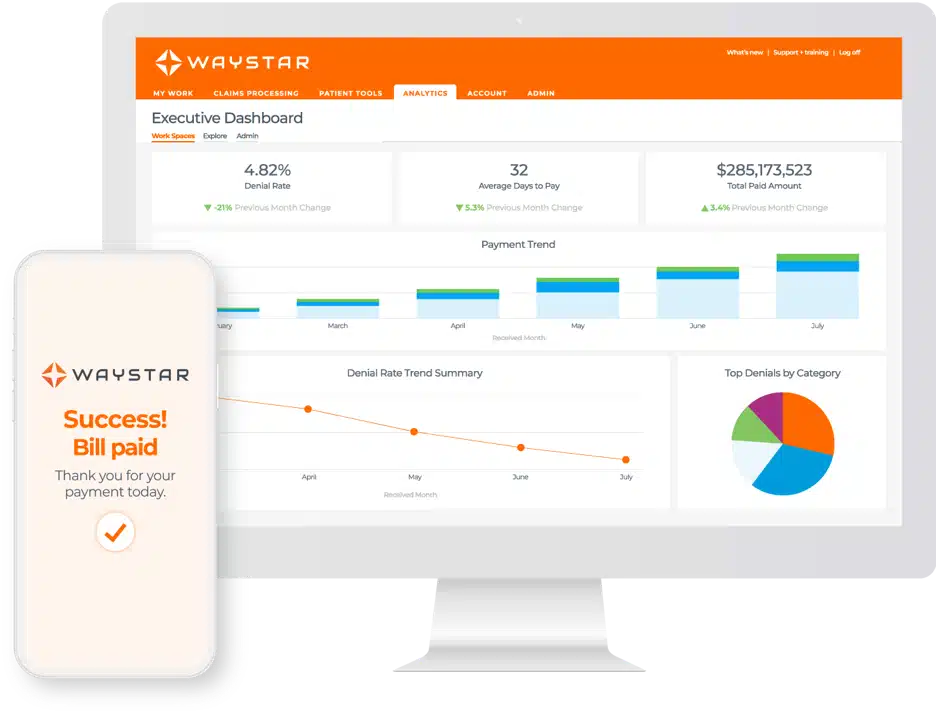
- Analytics + Reporting: Analytics, Medicare Analytics and Quality + Compliance Reporting
Waystar AltitudeAI is the name for the agentic AI, generative AI and automation that Waystar says runs across the platform to reduce denials and speed reimbursement. Its most recent acquisition, Iodine Software, added clinical documentation data.
HIPAA, security and integrations
Waystar announced HITRUST CSF certification in April 2021 and said it had also completed a SOC 2 Type II examination and achieved PCI DSS compliance. The platform was then hosted at a Flexential data center in Louisville, Kentucky. Ask for current reports, since certifications renew periodically. Waystar's supported systems list includes Epic, eClinicalWorks, NextGen, AdvancedMD, Kareo and Experity.
Waystar alternatives
- TriZetto Provider Solutions — clearinghouse and eligibility tools widely used by small and mid-size practices.
- Inovalon — eligibility, claims and Medicare DDE tools with a post-acute focus.
- athenahealth RCM — billing software and services tied to the athenaOne EHR.
- Quadax — claims and business intelligence for hospitals, labs and physician groups.
- R1 RCM — outsourced revenue cycle services for organizations that want to hand off billing.