Who NikoHealth is best for
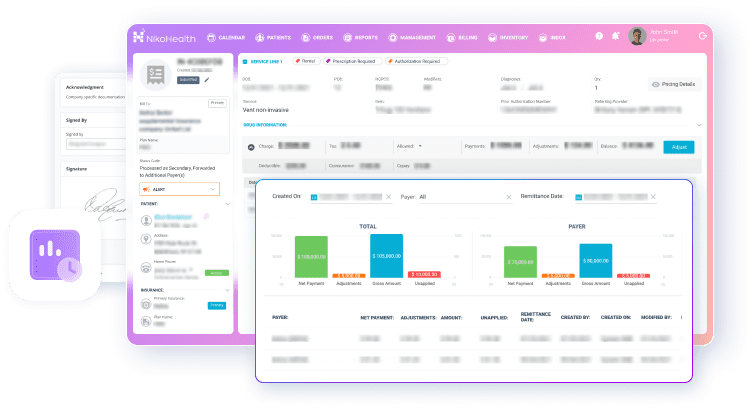
NikoHealth is built for home medical equipment (HME) and durable medical equipment (DME) suppliers, not physician offices. Its billing module sits inside a platform that also handles intake, documents, orders, inventory, resupply, routing and delivery, so claims tie directly to orders and proof of delivery.
Best for
- HME/DME suppliers replacing an older billing system or several disconnected tools
- Suppliers with recurring resupply business, such as CPAP, diabetic or incontinence supplies
- Companies that run their own delivery fleet and need a driver app with proof of delivery
- Operations teams that want payer rules and authorization tracking enforced before billing
Not ideal for
- Physician practices, clinics or therapy practices looking for medical billing software
- Small suppliers that want published, self-serve pricing
- Buyers who only need a stand-alone clearinghouse
NikoHealth pros and cons
Pros
- Purpose-built for HME/DME workflows, from intake through delivery and billing
- Eligibility checks through integrated clearinghouses return full responses, including out-of-pocket estimates, according to the vendor
- Payer rules can be customized by payer and plan, HCPCS code or specific item
- Authorization tracking warns when an authorization has expired or is about to
- Vendor states it is SOC 2 Type II audited, ISO 27001 compliant and will sign a BAA
- Open API and a partner network of billing, intake, fulfillment and AI document vendors
Cons
- No public pricing; costs are only available after a demo
- The vendor says small and mid-size DME implementations generally take 90 to 120 days
- Clearinghouse partners are not named publicly
- Not relevant for practices outside the HME/DME supply market
NikoHealth pricing
NikoHealth does not publish prices. It sells the cloud platform with implementation and support, and the vendor says pricing depends on business needs and configuration, quoted after a demo. Cost is likely to depend on modules licensed, users, transaction volume and the scope of data migration from your legacy system. Ask for implementation fees, contract length and any per-claim or per-eligibility charges in writing.
Key features
Named modules include:
- Billing and RCM: billing and invoicing, claim follow-up, identification of underpaid or denied claims, contract governance, payer performance comparison and data for rate negotiation
- Eligibility and authorizations: clearinghouse eligibility with out-of-pocket calculations, plus expiration alerts for authorizations
- Orders and Documents: order workflow and document management, with AI Intake Automation
- AI Resupply: recurring orders scheduled by frequency or payer eligibility
- Delivery App and NikoGo: mobile delivery app with proof of delivery, plus routing and dispatching
- Reporting: tracking of key RCM metrics, with KPI definitions and dashboards agreed during onboarding
- API Platform: open APIs for outside tools and partners
HIPAA, security and integrations
NikoHealth's security page states that it has a SOC 2 Type II audit with controls independently audited at least annually, is ISO 27001 compliant and "meets all HIPAA compliance standards." It says it will execute a business associate agreement at the customer's request. The application runs on AWS across multiple availability zones inside a VPC, and the vendor says data is protected with AES-256 encryption. It also states that vulnerability scans run at least quarterly and penetration testing at least annually.
NikoHealth offers an open API and a partner network that includes Parachute Health, Notable Systems, Tennr, CompliantRx, Fiserv and distributors such as McKesson and Medline. It does not name its clearinghouse partners.
NikoHealth alternatives
- Waystar — broad claims and payments platform, not an HME/DME operations system.
- Quadax — clearinghouse and denial tools that can sit alongside an existing billing system.
- TriZetto Provider Solutions — EDI clearinghouse and RCM services from Cognizant.
- Candid Health — API-first claims automation for teams with their own operations software.
- Office Ally — low-cost all-payer clearinghouse portal for basic claims and eligibility.