
Who HubSpot CRM is best for
HubSpot is a general-purpose CRM that HubSpot also markets to healthcare. Practices use it for the non-clinical side of growth: web inquiries, email campaigns, referral relationships and patient service requests, while charting stays in the EHR. The plan you need depends on whether patient health information will be stored in it.
Best for
- Practices and multi-location clinics running marketing campaigns and web lead capture
- Elective, cash-pay and wellness practices tracking inquiries to booked consultations
- Groups managing referring-provider relationships as a pipeline
- Digital health companies and healthcare vendors selling to providers
Not ideal for
- Practices that need to store PHI but cannot justify Enterprise pricing
- Clinics wanting a healthcare-specific CRM with native EHR data models
HubSpot CRM pros and cons
Pros
- Free CRM for up to two users with contacts, pipelines, forms, meeting scheduler, live chat and ticketing
- Marketing, sales and service tools share one contact record
- More than 2,000 apps in the HubSpot Marketplace, plus an open API
- BAA and HIPAA-covered data supported on Enterprise tiers with Sensitive Data enabled
- SOC 2 Type II report; data centers in the US, EU, Canada and Australia
Cons
- Not a clinical system and has no native EHR integrations
- PHI storage requires an Enterprise tier, priced in the thousands per month by third-party guides
- Sensitive Data properties cannot be used in personalization tokens, chatbots, sandboxes or playbooks
- Highly Sensitive Data properties are restricted further and encrypted values must be decrypted on click to view
- Professional and Enterprise tiers carry onboarding fees
HubSpot CRM pricing
HubSpot's pricing page lists a Free CRM for up to two users and a Starter tier at $20 per seat per month, with new-customer promotions as low as $7 per seat on annual billing. Professional and Enterprise prices are quote-based in practice. A May 2026 third-party guide lists Marketing Hub Enterprise from $3,600 per month with a $7,000 onboarding fee, and Sales Hub and Service Hub Enterprise seats at $150 per month with $3,500 onboarding fees; treat these as estimates.
Key features
- Smart CRM: contacts, companies, deals, tickets, custom objects and dashboards
- Marketing Hub: email, forms, landing pages and automation
- Sales Hub: pipelines, meeting links and sequences
- Service Hub: help desk, shared inbox, chatbot builder and surveys
- Content Hub, Data Hub and Revenue Hub
- Breeze AI: Breeze Assistant, Customer Agent, Prospecting Agent and Data Agent
- Sensitive Data tools: PHI-flagged properties, application-layer encryption, field-level access controls and audit logging
HIPAA, security and integrations
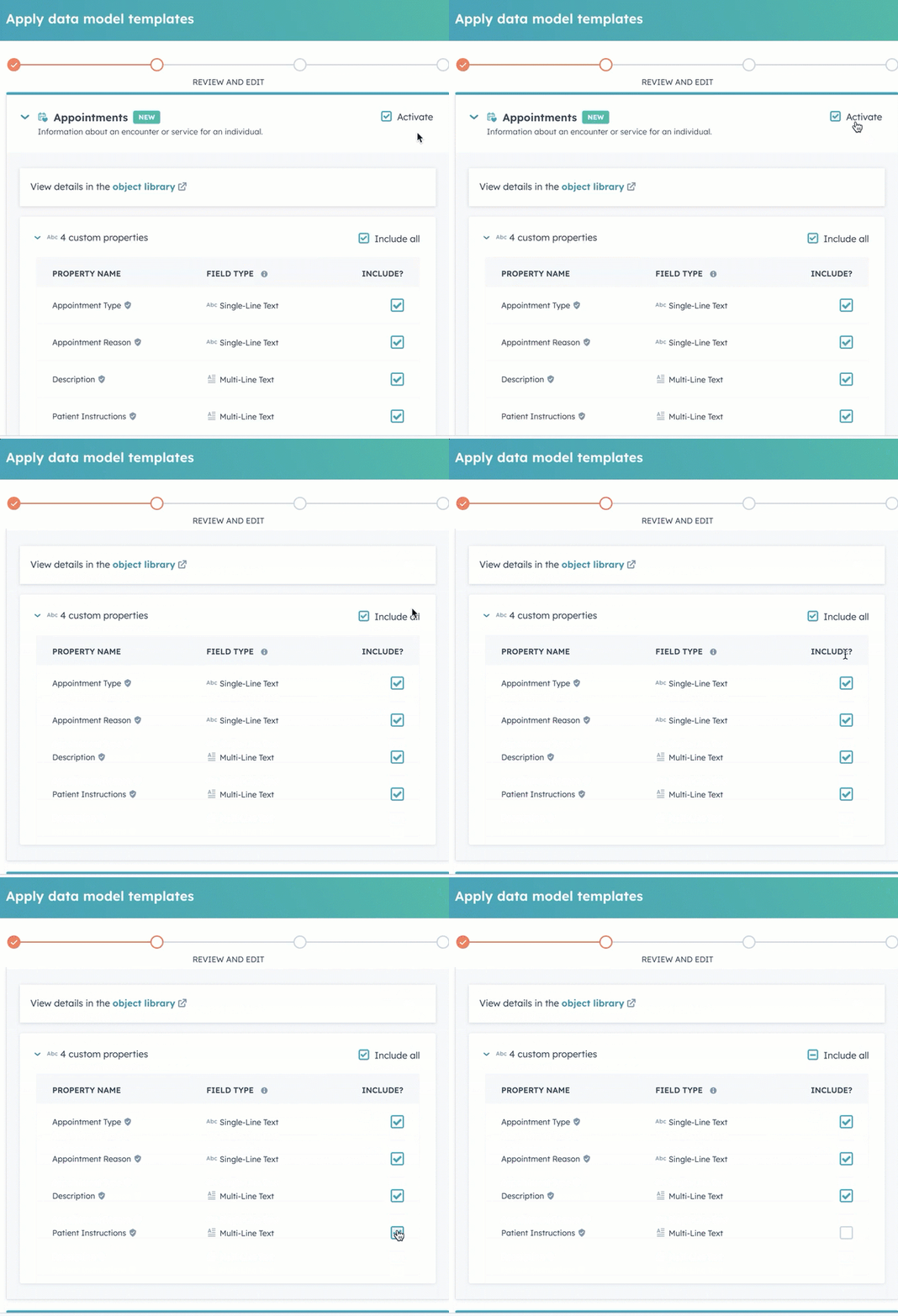
HubSpot's healthcare page says it signs a BAA with qualifying Enterprise customers. Its knowledge base says Sensitive Data is available on Enterprise tiers of Marketing Hub, Sales Hub, Service Hub, Data Hub, Content Hub and Smart CRM. A Super Admin enables it, selects Health/Medical Data, confirms the account is a covered entity or business associate and accepts the Sensitive Data Terms, which include the BAA. Controls include application-layer encryption, field-level access controls and audit logging; Super Admins can also turn Sensitive Data protection off later (a beta feature), and the change is recorded in the audit log. HubSpot does not publish native EHR integrations; its healthcare page says EHRs connect through APIs or third-party connectors.
HubSpot CRM alternatives
- Salesforce Health Cloud — healthcare-specific CRM with clinical data models, for larger organizations.
- LeadSquared — CRM with healthcare lead management and patient acquisition workflows.
- Freshsales — general-purpose CRM with lower per-seat pricing for pipeline and email needs.
- Cured by Innovaccer — healthcare marketing and patient engagement CRM built for health systems.